
At your own pace
IOL Decision Guide
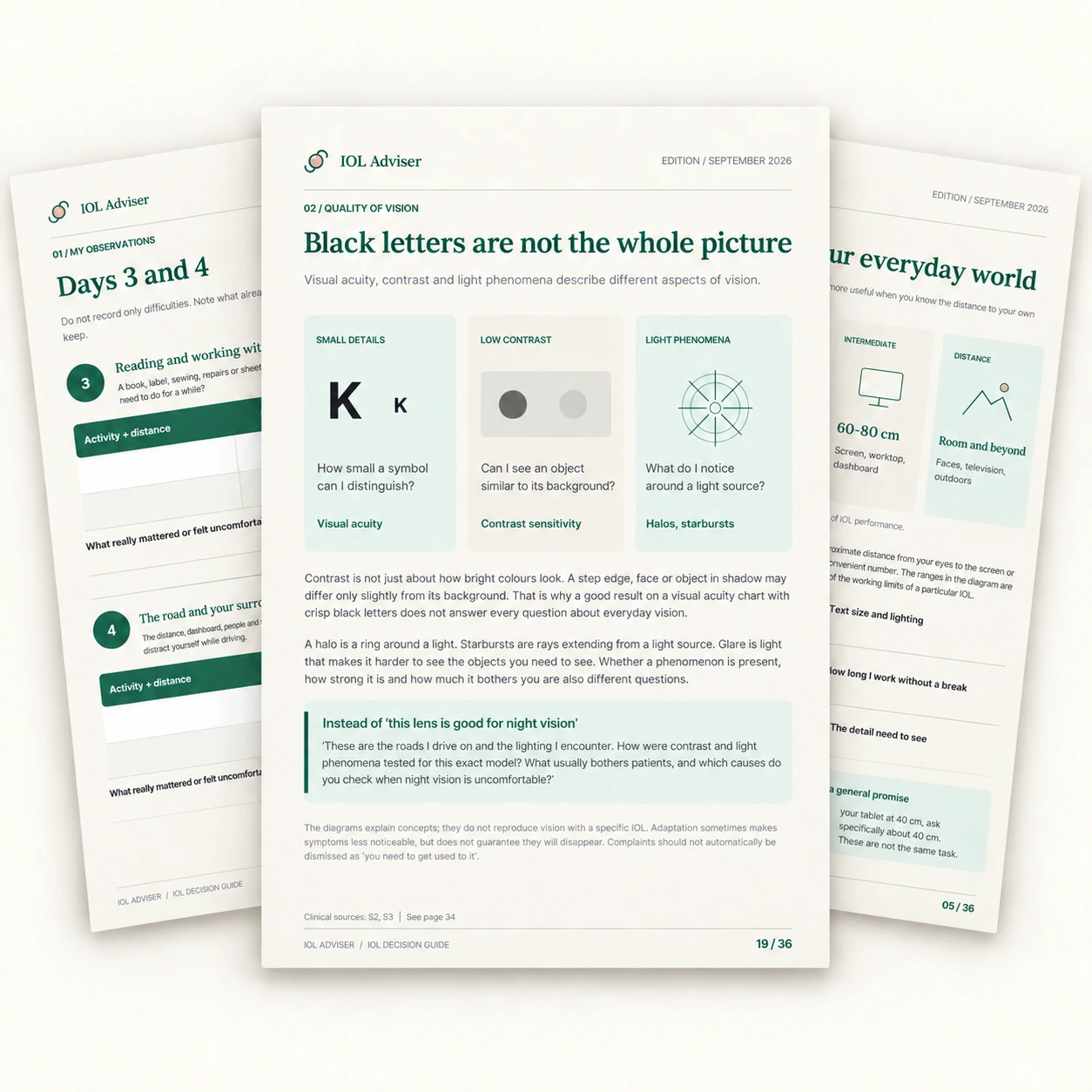
A 36-page guide with a seven-day vision diary, practical explanations and a one-page summary to take to your surgeon.
Explore the guide — €49PDF · one payment · no subscription
Cataract surgery can restore your vision — but different artificial lenses create different visual experiences. Learn how IOL options may affect reading, computer work, driving, night vision and dependence on glasses before discussing your final choice with your surgeon.

Understand what cataract is, when surgery may be considered and what happens next.
Understand the main lens categories, their benefits and their trade-offs.
Research the technology, expected visual range, limitations and alternatives.
Explore your visual priorities and daily activities before comparing lens options.
Reading a book, working at a screen, looking down the street: the same three tasks help explain the differences between lenses.

The comparison below assumes the lenses are chosen with distance vision in mind.
With the main focus set for distance, near reading usually needs glasses. A screen may also need a separate prescription.
*More often than with a standard monofocal. How much this helps depends on the particular lens and screen distance. Near reading still usually needs glasses.
Distance and computer work are the main strengths. Fine print and sustained near reading often still need glasses.
Designed to reduce reliance on glasses from distance to near. Small print or poor light can still make glasses useful.
This shows what each lens type aims to do, not a score or a prediction of your vision. Glasses may still be useful with any type. A monofocal can also be set for a nearer distance; choosing a different focus in each eye changes the picture. More about choosing the focus →
Reading the eye chart is one thing. Seeing comfortably through the rest of your day is another.
From the phone in your hand to the road ahead.
Understand thisDetails that are hard to pick out in fog, shade or against a similar background.
Understand thisWhat you can see when the light gets low.
Understand thisRings around lights and distracting brightness.
Understand thisWhich daily tasks still need glasses — and whether that bothers you.
Understand thisStart with your daily tasks. The questionnaire helps you put your visual priorities into words before discussing lens options with your surgeon.
Educational guidance, not a diagnosis.
The basics, without getting lost in model names.

Why eyes may burn, feel sandy or blur during screen work, what to tell an eye doctor, and when not to wait. Dry-eye symptoms are clues, not a diagnosis.

Hydrogel, silicone hydrogel and rigid gas-permeable contact lenses; why oxygen is not a comfort ranking, and what a proper fitting checks.

Practical dry-eye steps, why artificial tears differ, what omega-3 studies actually found, and what to discuss before cataract or laser surgery.
Work through your priorities at your own pace, or discuss the lenses you have been offered with Oleksii.
A 36-page guide with a seven-day vision diary, practical explanations and a one-page summary to take to your surgeon.
Explore the guide — €49PDF · one payment · no subscription

Discuss the proposed lenses, what you need from your vision and the questions still worth asking your surgeon.
See how a consultation worksEducational consultation — not an eye examination, diagnosis or treatment.